In general, absolute privilege exempts persons from liability for potentially defamatory statements made:
- during judicial proceedings.
- by high government officials.
- by legislators during legislative debates.
- during political broadcasts or speeches, and.
- in between spouses.
What are the 5 elements of defamation?
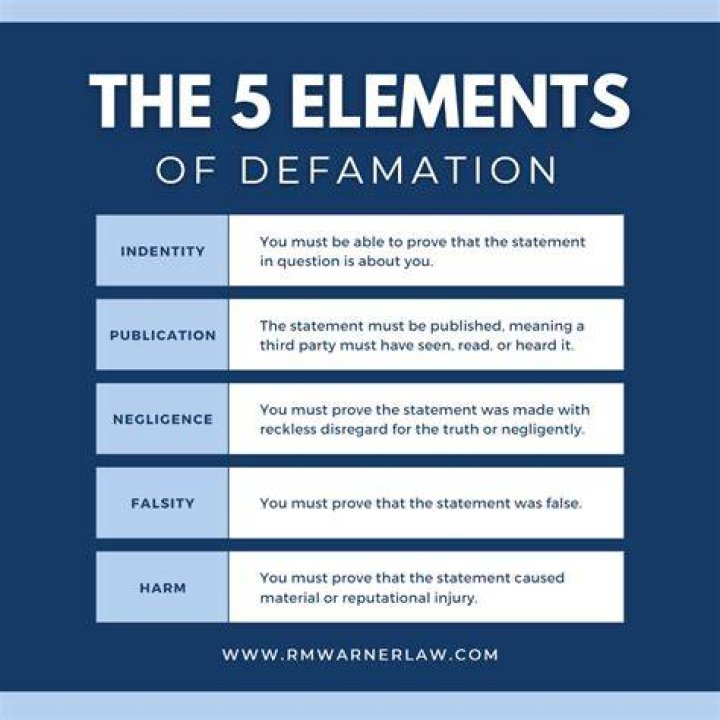
The five requisite elements of a defamation lawsuit?
- A statement of fact. Of course, for defamation to have occurred, somebody must have made the statement that is considered defamatory. ...
- A published statement. ...
- The statement caused injury. ...
- The statement must be false. ...
- The statement is not privileged. ...
- Getting legal advice.
What are the 6 elements of defamation?
Terms in this set (6)
- publication. Was there sufficient publication for a defamation case?
- Identification. Was there sufficient identification for a defamation case?
- Defamation. Was it defamatory?
- Fault. Was it their fault for the publication?
- False. Were the allegations false?
- Injury/ Harm.
What are the four 4 elements needed to show defamation?
To prove prima facie defamation, a plaintiff must show four things: 1) a false statement purporting to be fact; 2) publication or communication of that statement to a third person; 3) fault amounting to at least negligence; and 4) damages, or some harm caused to the person or entity who is the subject of the statement.
What are three common defenses to a defamation action?
The most common defenses to defamation are: 1) truth; 2) consent; 3) privilege; and 4) the statute of limitations. Perhaps the most distinct aspect of the defamation cause of action is that falsity is required. In other words, the statement publicized about the plaintiff must be false in order to prove defamation.
What are the exceptions to defamation?
What is the strongest defence to a defamation suit?
First and foremost, truth is an absolute defense to a defamation lawsuit. If the statement that is the subject of the suit is true, and you can prove it, your attorney can move to have the plaintiff's claim dismissed. No one is punished for speaking the truth, even if it is an ugly truth.
Which of the following is not a defense to defamation?
Which of the following is not a defense to defamation? Publication is an element of defamation, not a defense to defamation.
Who Cannot sue for defamation?
General groups (such as lawyers, doctors, people from a particular country, university students or the staff of a certain shop) cannot sue for defamation, unless the group is so small that a person could say she or he was readily identifiable.
What are the 2 types of defamation?
Libel and slander are types of defamatory statements. Libel is a defamatory statement that is written. Slander is a defamatory statement that is oral.
What is not defamation?
—It is not defamation to express in good faith any opinion whatever respecting the conduct of any person touching any public question, and respecting his character, so far as his character appears in that conduct, and no further. Illustration.
What are the 3 elements of defamation?
There are 3 necessary elements to a valid cause of action for defamation:
- Information was communicated by the defendant to a third person;
- The information identifies the plaintiff; and.
- The information had defamatory imputations about the plaintiff.
How many types of defamation are there?
There are two ways through which we can transmit the defamatory statement. One is through slander and another one is through libel. Libel is done through text or graphic and it is permanent in nature.
Can you sue someone for spreading rumors?
Your reputation, career, and home life could be in peril when someone spreads false and damaging information about you or your business. However, nobody has the right to ruin your reputation carelessly or maliciously. If you have been the victim of slander and incurred damages as a result, you could sue for defamation.
How do you prove defamation?
[8] The tort of defamation requires the plaintiff to prove three elements: (1) the defendant made a defamatory statement, in the sense that the impugned words would tend to lower the plaintiff's reputation in the eyes of a reasonable person; (2) the words in fact refer to the plaintiff; and (3) the words were ...
Which is not an element of defamation?
Because libel and slander are intentional torts, the defendant must have intended the publication. But malice, or actual ill will, is not an element of defamation.
Can I sue for defamation?
If someone hurts your reputation by making untrue statements about you, you may have grounds to sue for damages for defamation. The defaming statement made against you can fall into one of two categories: slander or libel. Slander refers to statements that are spoken, while libel refers to written defamation.
What is tort of defamation?
The tort of defamation acts to redress unjustified injury to the claimant's reputation and can be divided into two areas, slander and libel. Slander is the publication of defamatory words or actions in a temporary form, for example by spoken word. Libel is the publication of defamatory materials in permanent form.
Which of the following is a valid defense to a defamation claim?
Truth. Truth is an absolute defense to defamation. Remember that defamation is a false statement of fact. So, if the statement was accurate, then by definition it wasn't defamatory.
Is name calling defamation?
Did you know it is illegal to call people names? That is right it is illegal to insult someone. In the law, insulting someone is called slander if it was said and libel if it was done in writing. If you say or write something that is false and it ruins a persons reputation you could find yourself in a legal battle.
Who can and who Cannot sue defamation explain the reasons for this?
Individuals. Any living individual can sue for defamation; the dead cannot i.e. an estate or relatives of a deceased person cannot sue for libel over defamatory statements made about the deceased person.
Can I sue for false accusations?
You could sue them for libel or slander. Technically these crimes are torts rather than criminal offences so an arrest wouldn't occur.
Why are defamation cases hard to win?
The reason for this is that to win, there is a lot of fact-finding involved, which often requires the assistance of an expert. Even if you win the case, information could leak to the public, leaving people with the wrong impression.
Is opinion a defense to defamation?
Several recent dismissals of defamation claims based on statements the courts found to be constitutionally protected opinion have reaffirmed the opinion defense as one of the most potent tools available to individuals or organizations sued for libel.
Can a true statement be defamation?
Falsity - Defamation law will only consider statements defamatory if they are, in fact, false. A true statement is not considered defamation in many states. In some states, truth is a defense (see below).
What is justification in defamation?
Section 8 provides that a Defendant can raise a defence of justification in a defamation suit. A defence of justification simply means that the published statements or allegations are true and such defence is an absolute defence if proven successfully.